
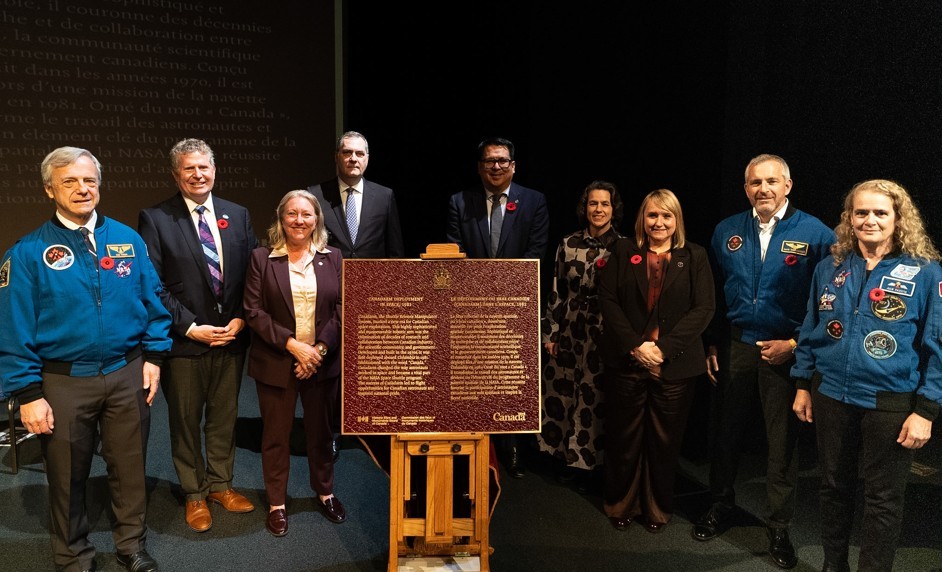

Canada’s pioneering role in space exploration has earned another place in the nation’s history books, as the Government of Canada officially recognized the 1981 deployment of Canadarm as a national historic event. The designation celebrates a technological breakthrough that helped establish Canada as a leader in space robotics and transformed the country’s contributions to international space exploration.
At a commemorative plaque unveiling at the Canada Aviation and Space Museum in Ottawa, Wade Grant, Parliamentary Secretary to the Minister of Environment and Climate Change, joined representatives from the Historic Sites and Monuments Board of Canada and the Canadian Space Agency to recognize Canadarm’s enduring legacy. Grant attended on behalf of the Honourable Julie Dabrusin, Minister of the Environment, Climate Change and Nature and Minister responsible for Parks Canada.
Developed during the 1970s, the Shuttle Remote Manipulator System, better known as Canadarm, represented a remarkable achievement in Canadian engineering. The sophisticated robotic arm emerged from decades of scientific research and collaboration involving Canadian industry, researchers, and government.
Its historic debut came in 1981 aboard the Space Shuttle Columbia. Bearing the Canadian flag and the word “Canada,” Canadarm quickly became a powerful symbol of national ingenuity and technological ambition.
Over the following decades, the robotic system became an essential tool in space operations. It deployed satellites into orbit, retrieved spacecraft for repairs, supported astronauts during spacewalks, and contributed to the assembly of the International Space Station alongside its successor, Canadarm2.
“The 1981 Canadarm deployment in space was a defining moment in our national story. It proved that Canadian ingenuity could reach beyond our borders and into space, and the pride Canadians felt was shared across the country. Canadarm supported space exploration, and over time, it helped shape it. It remains a powerful symbol of who we are as a country, and the ambition we bring to reach new horizons,” expressed the Honourable Julie Dabrusin, Minister of the Environment, Climate Change and Nature.
Beyond its technical achievements, Canadarm helped position Canada as a trusted international partner in space exploration while inspiring generations of scientists, engineers, and astronauts.
That legacy continues to influence Canada’s ambitions as international space programs prepare for renewed lunar exploration and missions deeper into space.
“For 45 years, Canadarm has shown the world what Canada can achieve when we invest in our people, our ideas, and our ability to innovate. That legacy has made Canada a trusted partner in space exploration and created opportunities for generations of Canadian scientists, engineers, and astronauts. As we return to the Moon and explore further into deep space, Canada will be there, building on our expertise in innovation and space technology, creating new opportunities here at home, and ensuring Canadian talent continues to play a key role in shaping the future of space exploration,” said the Honourable Mélanie Joly, Minister of Industry and Minister responsible for Canada Economic Development for Quebec Regions.
The national historic designation, administered through Parks Canada and the Historic Sites and Monuments Board of Canada, recognizes the significance of Canadarm’s first deployment in shaping Canada’s scientific and technological identity. Through its National Program of Historical Commemoration, Parks Canada highlights the people, places, and events that have helped define the country. The public can also nominate historically significant subjects for consideration. Forty-five years after Canadarm first reached into space, its legacy remains a testament to Canadian innovation, international collaboration, and the country’s continuing ambition to help shape humanity’s future beyond Earth.
